


Why Homoeopathy Journals Need a Modern Manuscript Submission and Peer Review System
Why Homoeopathy Journals Need a Modern Manuscript Submission and Peer Review System
Homoeopathy research has grown significantly over the last two decades. Increasing numbers of clinicians, postgraduate scholars, research institutions, and homoeopathic medical colleges are contributing to scientific literature through original research articles, case reports, review papers, and integrative healthcare studies. As the volume of submissions continues to increase, the expectations of authors and reviewers have also changed.
Modern researchers expect journals to provide a professional digital experience that includes online manuscript submission, transparent peer review, automated communication, and efficient editorial decision-making. Unfortunately, many journals still depend on email-based submission systems or outdated publishing platforms that create unnecessary delays and administrative burdens.
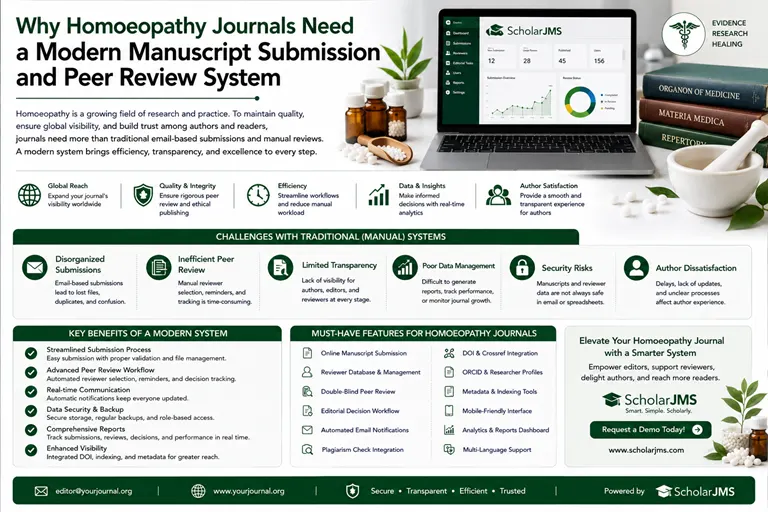
In today's competitive academic publishing environment, a modern manuscript submission and peer review system is no longer a luxury. It has become an essential requirement for any journal that wishes to maintain credibility, attract quality submissions, and provide a positive experience for authors and reviewers.
For homoeopathy journals in particular, adopting a modern publishing infrastructure can significantly improve editorial efficiency and contribute to the growth of evidence-based homoeopathic research.
The Changing Landscape of Scholarly Publishing
Academic publishing has undergone tremendous transformation in recent years.
Authors now expect journals to provide:
- Online manuscript submission
- Real-time submission tracking
- Transparent communication
- Faster editorial decisions
- Mobile-friendly platforms
- Secure data management
- Professional publication workflows
Reviewers similarly expect:
- Simple review interfaces
- Automated reminders
- Easy access to manuscripts
- Structured review forms
- Efficient communication channels
Journals that fail to provide these features often struggle to retain authors and reviewers.
Challenges Faced by Traditional Homoeopathy Journals
Many emerging and institutional journals continue to use manual workflows.
Common problems include:
Email-Based Submissions
Manuscripts sent through email can easily become disorganized, resulting in:
- Lost files
- Version confusion
- Delayed communication
- Administrative burden
Manual Reviewer Assignment
Without a dedicated system, editors spend significant time:
- Identifying reviewers
- Sending review requests
- Following up on reminders
- Tracking responses
Lack of Workflow Transparency
Authors frequently ask:
- Has my manuscript been received?
- Is it under review?
- When will I receive a decision?
Without an online system, responding to these queries becomes difficult.
Delayed Publication
Inefficient workflows often lead to:
- Longer turnaround times
- Frustrated authors
- Reduced submission rates
- Loss of journal credibility
Why a Modern Manuscript Submission System Matters
A professional journal management platform can completely transform editorial operations.
Streamlined Submission Process
Authors can:
- Register online
- Submit manuscripts directly
- Upload supplementary files
- Track manuscript progress
- Receive automated notifications
This significantly improves the author experience.
Centralized Editorial Management
Editors can:
- View all submissions in one dashboard
- Assign manuscripts to editors and reviewers
- Track deadlines
- Communicate efficiently
- Monitor journal performance
Improved Data Organization
Modern systems maintain:
- Submission history
- Reviewer databases
- Decision records
- Author information
- Publication metadata
This improves operational efficiency and reduces errors.
Importance of an Efficient Peer Review System
Peer review is the foundation of scholarly publishing.
A modern peer review system helps journals:
- Maintain scientific quality.
- Ensure transparency.
- Improve reviewer engagement.
- Reduce administrative workload.
- Shorten decision timelines.
Double-Blind Review Management
Most homoeopathy journals prefer double-blind peer review.
Modern platforms automatically manage:
- Reviewer anonymity
- Author anonymity
- Review assignments
- Reviewer communications
- Decision tracking
This reduces administrative complexity.
Benefits for Authors
Researchers increasingly choose journals that provide a smooth digital experience.
A modern submission platform offers:
Transparency
Authors can monitor every stage of the review process.
Faster Communication
Automated notifications keep authors informed.
Professional Experience
An efficient submission process creates confidence in the journal.
Improved Trust
Transparent workflows encourage repeat submissions.
Author satisfaction is one of the most important factors influencing the long-term success of a journal.
Benefits for Reviewers
Reviewers are essential partners in scholarly publishing.
A modern platform helps reviewers by providing:
- Organized review dashboards
- Structured review forms
- Automated reminders
- Easy access to manuscripts
- Simplified communication
Reducing reviewer workload improves participation and review quality.
Benefits for Editors
Editorial teams often spend considerable time managing administrative tasks.
Modern systems allow editors to:
- Automate repetitive activities
- Monitor submission progress
- Manage reviewer databases
- Generate reports
- Improve turnaround times
This enables editors to focus more on publication quality and scientific standards.
Why Homoeopathy Journals Specifically Need Modern Systems
Homoeopathy research often includes:
- Clinical case reports
- Longitudinal studies
- Case series
- Integrative healthcare research
- Educational studies
- Public health research
Managing these diverse submissions requires a flexible and organized workflow.
Modern systems also facilitate:
- Supplementary file management
- Ethical declarations
- Conflict of interest forms
- Reviewer comments
- Version control
These features are increasingly expected by authors and indexing agencies.
The Importance of Publication Ethics and Transparency
Modern publishing systems help journals implement:
- Publication ethics policies
- Plagiarism checks
- Conflict of interest disclosures
- Data sharing statements
- Corrections and retractions management
Strong editorial policies improve journal credibility and indexing readiness.
The Role of DOI and Metadata Management
Digital publishing is closely connected with article discoverability.
Modern journal systems should support:
- DOI assignment
- Metadata management
- Citation export
- Search engine optimization
- Indexing readiness
Proper metadata management significantly improves article visibility and citation potential.
Why Journal Websites and Editorial Systems Must Work Together
A journal website is no longer simply an information portal.
It should function as an integrated ecosystem that combines:
- Journal information pages
- Submission workflows
- Peer review management
- Publication archives
- Editorial communication
- Article publishing
A disconnected workflow often creates operational inefficiencies.
Moving Beyond Traditional Publishing Workflows
The expectations of authors and institutions continue to rise.
Modern journals are increasingly adopting:
- Cloud-based journal management systems
- Automated editorial workflows
- Reviewer databases
- Real-time tracking
- Analytics and reporting tools
- Digital publishing standards
Journals that embrace these technologies are often better positioned for sustainable growth.
Why Many Journals Are Upgrading Their Publishing Platforms
Many journals initially begin with basic publishing solutions but later encounter challenges such as:
- Increasing submission volume
- Limited technical support
- Workflow inefficiencies
- Complex system maintenance
- Difficulty implementing new features
These challenges often motivate journals to adopt modern publishing platforms designed specifically for scholarly communication.
ScholarJMS: A Modern Publishing Solution for Journals
Modern journals increasingly require an integrated platform that combines:
- Journal website management
- Manuscript submission
- Editorial workflows
- Peer review management
- Article publishing
- Metadata management
- DOI-ready infrastructure
ScholarJMS provides a comprehensive journal management platform designed to support the complete publishing lifecycle of academic journals.
The platform can help journals:
- Simplify editorial management.
- Improve author experience.
- Enhance reviewer engagement.
- Reduce publication delays.
- Strengthen digital publishing infrastructure.
Planning an OJS Migration or Journal Upgrade?
Many journals are now exploring opportunities to upgrade their publishing systems or migrate from older workflows.
OJSCloud provides support for:
- OJS hosting and maintenance
- OJS migration services
- Journal launch consulting
- ISSN consulting
- Editorial workflow setup
- Publishing infrastructure planning
Need Help Upgrading Your Journal?
We can help with:
- Journal website development
- ScholarJMS setup
- OJS migration
- ISSN consulting
- Editorial workflow implementation
- Technical publishing support
WhatsApp: +91 82003 85143
Email: inquiry@ojscloud.com
Why DOI Planning Matters
A modern publishing workflow should include DOI planning from the beginning.
DOIs provide:
- Permanent article identification
- Improved citation management
- Better discoverability
- Metadata standardization
- International visibility
GetDOI can assist journals with:
- Crossref DOI support
- DOI implementation guidance
- Metadata workflows
- Technical setup assistance
Transparent Peer Review and Research Trust
Modern scholarly publishing increasingly emphasizes transparency and research integrity.
Scholar9 contributes to building research trust ecosystems and promoting transparent scholarly communication.
Journals that adopt transparent publishing practices often improve credibility and strengthen relationships with authors and reviewers.
Frequently Asked Questions
Why should a homoeopathy journal use an online manuscript submission system?
An online system improves workflow efficiency, reduces administrative workload, and enhances the author experience.
Is email-based manuscript handling still suitable?
For very small journals it may be manageable, but growing journals generally require dedicated publishing systems for scalability and transparency.
What is the biggest advantage of a modern peer review system?
It improves communication, reviewer management, and editorial efficiency while reducing publication delays.
Can an existing journal migrate to a new platform?
Yes. Many journals successfully migrate from traditional workflows or older platforms to modern journal management systems.
Does a modern platform improve indexing readiness?
Yes. Better metadata management, DOI support, and publication transparency contribute significantly to indexing preparedness.
Conclusion
The future of scholarly publishing depends on efficiency, transparency, and digital innovation. For homoeopathy journals, adopting a modern manuscript submission and peer review system is no longer optional. It is essential for improving editorial operations, enhancing author and reviewer experiences, and maintaining scientific credibility.
As homoeopathy research continues to expand globally, journals must invest in robust digital infrastructure that supports evidence-based publishing and sustainable growth. Modern publishing platforms can help journals reduce administrative burdens, improve publication timelines, and provide a professional experience that attracts quality submissions.
Whether you are launching a new homoeopathy journal or upgrading an existing publication, investing in a modern manuscript submission and peer review system is one of the most important decisions for long-term success.
Need Help Launching or Upgrading Your Journal?
We can help with:
- ScholarJMS journal website setup
- OJS migration and support
- ISSN consulting
- Crossref DOI support
- Editorial workflow implementation
- Journal launch guidance
WhatsApp: +91 82003 85143
Email: inquiry@ojscloud.com
Build a modern publishing infrastructure today and create a stronger future for homoeopathy research and scholarly communication.