

Role of Homoeopathy in Integrative Healthcare: Research Opportunities for Scholars
Role of Homoeopathy in Integrative Healthcare: Research Opportunities for Scholars
Healthcare systems around the world are undergoing a significant transformation. The growing burden of chronic diseases, rising healthcare costs, increasing patient expectations, and the demand for patient-centered care have encouraged healthcare providers to explore more comprehensive and collaborative treatment approaches. This shift has contributed to the rapid growth of integrative healthcare, a model that combines conventional medicine with evidence-based complementary and traditional healthcare practices.
Among the various complementary systems of medicine, homoeopathy has emerged as an important area of interest because of its individualized treatment approach, holistic philosophy, and long history of clinical practice. Millions of patients across the world seek homoeopathic care either as a primary healthcare option or alongside conventional treatment.
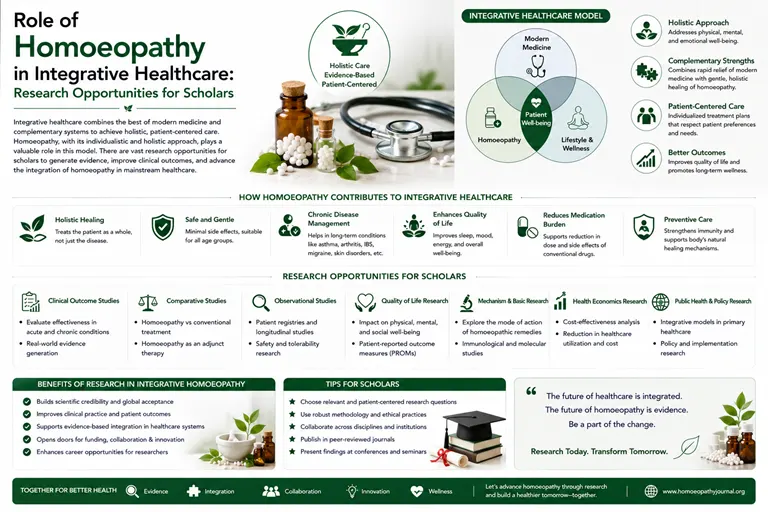
As integrative healthcare continues to gain recognition globally, there is a growing need for high-quality scientific research that examines the role of homoeopathy in collaborative healthcare models. This presents significant opportunities for clinicians, academicians, postgraduate scholars, and researchers.
Materia Novum: The Journal of Homoeopathy is committed to promoting scientific inquiry and scholarly publication in homoeopathy and integrative medicine by providing a platform for evidence-based research and interdisciplinary collaboration.
Understanding Integrative Healthcare
Integrative healthcare refers to a patient-centered approach that combines conventional medicine with complementary healthcare practices that are supported by scientific evidence and clinical experience.
The principles of integrative healthcare include:
- Treating the whole person rather than only the disease.
- Emphasizing prevention and wellness.
- Encouraging patient participation in healthcare decisions.
- Supporting physical, emotional, and mental well-being.
- Promoting collaboration among healthcare professionals.
The ultimate objective of integrative healthcare is to improve patient outcomes, quality of life, and overall healthcare experiences.
Why Integrative Healthcare Is Becoming More Important
Several factors have contributed to the increasing adoption of integrative healthcare practices.
Rising Burden of Chronic Diseases
Chronic illnesses such as diabetes, arthritis, asthma, hypertension, and mental health disorders require long-term management strategies that often extend beyond symptom control.
Increasing Patient Demand
Many patients actively seek complementary healthcare options to improve their quality of life and address emotional and psychological aspects of illness.
Focus on Personalized Medicine
Modern healthcare increasingly recognizes the importance of individualized treatment approaches, an area where homoeopathy has traditionally placed significant emphasis.
Holistic Patient Care
Patients often prefer treatment approaches that consider physical, mental, emotional, and lifestyle factors simultaneously.
These developments have created significant opportunities for research involving homoeopathy within integrative healthcare systems.
The Place of Homoeopathy in Integrative Healthcare
Homoeopathy has several characteristics that align with the principles of integrative medicine.
These include:
- Individualized treatment strategies
- Holistic patient assessment
- Emphasis on long-term health and well-being
- Patient-centered therapeutic relationships
- Consideration of mental and emotional health
In many countries, patients utilize homoeopathy alongside conventional medicine for managing chronic illnesses and improving quality of life.
This growing utilization highlights the importance of conducting rigorous scientific research to better understand the contribution of homoeopathy within integrative healthcare settings.
Potential Areas of Integrative Healthcare Research in Homoeopathy
Researchers and scholars have numerous opportunities to investigate the role of homoeopathy in various healthcare settings.
Chronic Disease Management
Chronic diseases represent one of the most important areas for integrative healthcare research.
Potential research topics include:
- Diabetes management
- Asthma and allergic disorders
- Arthritis and musculoskeletal diseases
- Chronic skin conditions
- Thyroid disorders
- Mental health conditions
Research may focus on:
- Quality of life outcomes
- Patient satisfaction
- Healthcare utilization
- Long-term clinical outcomes
Integrative Oncology
Supportive cancer care has become an important area of integrative medicine.
Potential research topics include:
- Symptom management
- Fatigue and quality of life assessments
- Psychological well-being
- Supportive care interventions
Mental Health and Emotional Well-Being
Mental health disorders have become a major global health concern.
Potential areas of research include:
- Anxiety disorders
- Stress management
- Sleep disturbances
- Psychosomatic disorders
- Depression-related quality of life studies
Women's Health
Research opportunities include:
- Menstrual disorders
- Menopausal symptoms
- Pregnancy-related supportive care
- Polycystic ovarian syndrome
- Reproductive health and wellness
Pediatric Integrative Healthcare
Potential areas include:
- Recurrent respiratory infections
- Allergic disorders
- Behavioral and emotional health
- Child quality of life assessments
Public Health and Community Medicine
Researchers can explore:
- Community healthcare models
- Health promotion programs
- Lifestyle interventions
- Preventive healthcare initiatives
Research Methods Suitable for Integrative Healthcare Studies
The future of homoeopathy in integrative medicine depends largely on the quality of research produced.
Several scientific methodologies can be used effectively.
Observational Studies
Observational research can provide valuable real-world evidence regarding patient outcomes and treatment experiences.
Examples include:
- Prospective studies
- Retrospective studies
- Cohort studies
- Registry-based studies
Case Reports and Case Series
Case reports continue to play an important role in generating hypotheses and identifying potential research questions.
Well-documented cases can:
- Highlight unique clinical experiences.
- Demonstrate patient-centered outcomes.
- Encourage larger investigations.
Clinical Trials
Clinical trials remain essential for evaluating healthcare interventions.
Possible study designs include:
- Randomized controlled trials
- Pragmatic trials
- Comparative effectiveness studies
- Multi-center studies
Qualitative Research
Qualitative research methods can help understand:
- Patient experiences
- Treatment expectations
- Healthcare decision-making
- Satisfaction with integrative care
Mixed Methods Research
Combining quantitative and qualitative methodologies provides a more comprehensive understanding of healthcare interventions.
Importance of Outcome Measures in Integrative Healthcare Research
Outcome measures are critical for evaluating patient-centered healthcare interventions.
Researchers should consider:
- Quality of life questionnaires
- Patient-reported outcome measures
- Functional assessment scales
- Psychological well-being indices
- Symptom severity scores
- Healthcare utilization indicators
The use of validated outcome measures improves the credibility and scientific value of research findings.
Emerging Research Trends in Integrative Healthcare
Several emerging trends are likely to influence future research.
These include:
- Digital health and telemedicine
- Artificial intelligence and healthcare analytics
- Personalized medicine
- Big data and clinical registries
- Population health studies
- Health economics and cost-effectiveness analyses
- Collaborative healthcare models
These developments create significant opportunities for scholars interested in homoeopathy and integrative medicine research.
Publication Opportunities for Scholars
The increasing interest in integrative healthcare has created a growing demand for high-quality scholarly publications.
Researchers can contribute through:
- Original research articles
- Clinical studies
- Review papers
- Systematic reviews
- Meta-analyses
- Case reports
- Public health studies
- Educational research
- Healthcare policy analyses
Materia Novum: The Journal of Homoeopathy welcomes scholarly contributions that advance the understanding of homoeopathy and its role in integrative healthcare.
The journal encourages submissions from:
- Clinicians
- Faculty members
- Postgraduate scholars
- Researchers
- Public health professionals
- Interdisciplinary healthcare teams
Why Publishing Integrative Healthcare Research Matters
Research that remains unpublished cannot contribute effectively to scientific advancement.
Academic publishing helps:
- Share knowledge globally.
- Build evidence-based practice.
- Improve professional standards.
- Encourage interdisciplinary collaboration.
- Support healthcare policy development.
- Advance patient-centered healthcare.
Scholarly publication therefore plays an essential role in the future development of integrative healthcare and homoeopathy.
Opportunities for Young Researchers and Postgraduate Scholars
Integrative healthcare research offers numerous opportunities for emerging scholars.
Potential projects include:
- Quality of life studies
- Clinical documentation projects
- Comparative studies
- Community health research
- Patient-reported outcome research
- Digital health initiatives
- Health services research
Participation in research activities allows young scholars to contribute meaningfully to both academic development and patient care.
Frequently Asked Questions
What is integrative healthcare?
Integrative healthcare combines conventional medicine with evidence-based complementary healthcare practices to provide patient-centered and holistic care.
Why is homoeopathy important in integrative healthcare?
Homoeopathy emphasizes individualized treatment, holistic assessment, and long-term patient well-being, making it relevant within integrative healthcare systems.
What are the major research opportunities in integrative healthcare?
Research opportunities include chronic disease management, mental health, supportive cancer care, public health, digital health, and patient-reported outcome studies.
Can postgraduate students publish research in integrative healthcare?
Yes. Many peer-reviewed journals encourage submissions from postgraduate scholars and early-career researchers.
What type of articles does Materia Novum accept?
The journal accepts original research articles, review papers, case reports, short communications, and scholarly contributions related to homoeopathy and integrative medicine.
Conclusion
Integrative healthcare represents one of the most promising directions in modern medicine, emphasizing collaboration, patient-centered care, and holistic approaches to health and well-being. Homoeopathy, with its individualized and comprehensive philosophy, has significant potential to contribute to this evolving healthcare landscape.
However, the future role of homoeopathy in integrative healthcare depends on the generation of high-quality scientific evidence, rigorous research methodologies, and transparent scholarly publication. Researchers, clinicians, and postgraduate scholars have an important opportunity to investigate how homoeopathy can contribute to improving patient outcomes and advancing interdisciplinary healthcare.
Materia Novum: The Journal of Homoeopathy remains committed to promoting scientific research and providing a scholarly platform for clinicians and researchers dedicated to advancing homoeopathy and integrative medicine.
Researchers interested in integrative healthcare are encouraged to document their findings and contribute to the growing body of evidence that will shape the future of patient-centered healthcare.