


OJS vs ScholarJMS: Which Platform Is Better for New Medical and Homoeopathy Journals?
OJS vs ScholarJMS: Which Platform Is Better for New Medical and Homoeopathy Journals?
Starting a new academic journal is no longer simply about publishing articles online. Modern journals are expected to provide a professional digital experience, transparent peer review, efficient editorial workflows, DOI integration, indexing readiness, and strong publication ethics.
For medical and homoeopathy journals, these expectations are even higher because healthcare research depends heavily on credibility, scientific transparency, and long-term accessibility.
When launching a new journal, one of the first questions publishers ask is:
Should we use Open Journal Systems (OJS) or choose a modern platform like ScholarJMS?
Both platforms can help journals publish scholarly content, but they differ significantly in terms of setup, workflow management, technical requirements, support, and long-term scalability.
This article compares OJS and ScholarJMS to help journal founders, editors, institutions, and publishers make an informed decision.
Understanding OJS
Open Journal Systems, commonly known as OJS, is an open-source journal publishing platform developed by the Public Knowledge Project. It provides tools for manuscript submission, peer review, editorial management, and publication workflows. OJS has been widely adopted by thousands of journals around the world, particularly because of its open-source nature.
Because OJS is open source, journals can customize and host the software independently or through third-party service providers.
Advantages of OJS
- No software licensing cost.
- Large global user community.
- Supports peer review workflows.
- Supports multiple languages.
- Highly customizable through plugins.
- Suitable for technically experienced institutions.
Challenges of OJS
Many new journals underestimate the operational challenges associated with OJS.
Common issues include:
- Technical installation requirements
- Server management responsibilities
- Software updates and maintenance
- Plugin compatibility issues
- Security management
- Manual DOI configuration
- Complex customization requirements
- Need for technical expertise
For small institutions and new publishers, these challenges can become significant barriers.
Understanding ScholarJMS
ScholarJMS is a cloud-based journal management system designed specifically for academic journals and publishers. It combines journal website management, manuscript submission, peer review, publication workflows, and DOI support within a single integrated platform.
The platform is designed to reduce technical complexity and allow editors to focus on publishing rather than software administration.
ScholarJMS offers:
- Journal website builder
- Manuscript submission system
- Editorial workflow automation
- DOI-ready infrastructure
- Multi-journal management
- Transparent peer review capabilities
- Technical support and onboarding assistance
- Integrated publishing tools
According to the platform, journals can be launched rapidly with built-in support for publishing workflows and indexing readiness.
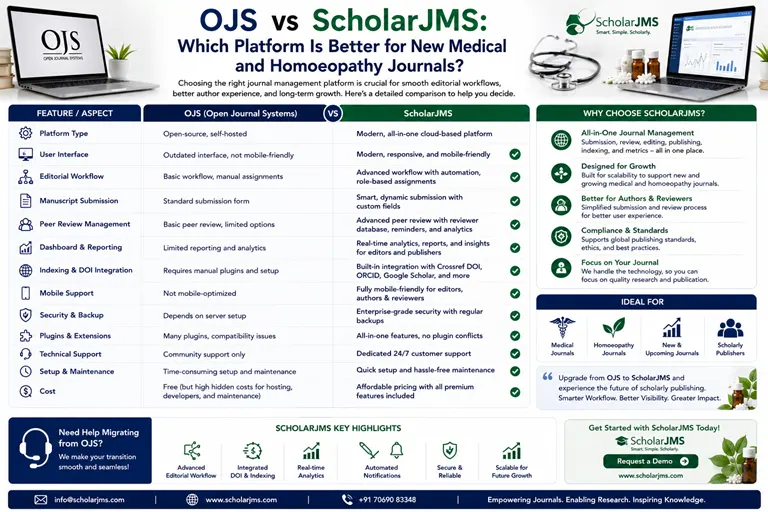
OJS vs ScholarJMS: Feature Comparison
| Feature | OJS | ScholarJMS |
|---|---|---|
| Software Cost | Free software | Commercial cloud platform |
| Setup Time | Days to weeks | Rapid deployment |
| Technical Knowledge Required | High | Low |
| Hosting Management | Required | Managed |
| DOI Integration | Manual setup | Integrated support |
| Journal Website Builder | Available with customization | Built-in |
| Technical Support | Community-based | Dedicated support |
| Workflow Automation | Moderate | Advanced |
| Multi-Journal Management | Possible with configuration | Built-in |
| Maintenance Responsibility | Journal owner | Platform provider |
| Security Updates | Manual | Managed |
| Onboarding Assistance | Limited | Extensive |
Why New Medical and Homoeopathy Journals Face Unique Challenges
Medical and homoeopathy journals often require:
- Double-blind peer review
- Case report workflows
- Ethical declarations
- Supplementary file management
- Reviewer databases
- DOI assignment
- Indexing readiness
- Publication transparency
Many new journals struggle because they underestimate the operational complexity of these requirements.
A publishing platform should simplify these processes rather than create additional technical burdens.
Journal Website Development Matters More Than Ever
A journal website is no longer just an online brochure.
It is expected to function as:
- Information portal
- Submission platform
- Editorial office
- Publication archive
- Author communication system
- Research dissemination platform
Modern researchers often evaluate the quality of a journal by the professionalism and usability of its website.
A poorly managed website can discourage authors from submitting manuscripts.
The Importance of Technical Support
One of the most overlooked factors in choosing a journal management system is support.
Many editorial teams consist primarily of:
- Faculty members
- Researchers
- Clinicians
- Academic administrators
Most do not have dedicated IT teams.
In such situations, technical support becomes essential.
Questions such as:
- Why is the website not loading?
- How should DOI be configured?
- Why are emails not being delivered?
- How can metadata be corrected?
require prompt assistance.
Dedicated support can significantly reduce operational stress.
Why DOI Integration Is Important
Every modern journal should consider DOI planning from the beginning.
Crossref DOI registration improves:
- Citation management
- Article discoverability
- Long-term accessibility
- Metadata quality
- International visibility
Many journals experience difficulties implementing DOI workflows because of technical complexity.
Need DOI Support?
GetDOI provides support for:
- Crossref DOI guidance
- Metadata management
- DOI workflows
- Technical implementation assistance
ISSN Readiness Is Often Overlooked
Many publishers apply for ISSN without first ensuring that their journal website and policies meet expected standards.
ISSN readiness typically requires:
- Functional journal website
- Editorial information
- Publication policies
- Publishing schedule
- Author guidelines
Proper preparation can simplify the application process.
Need Help with ISSN and Journal Launch?
OJSCloud provides support for:
- ISSN consulting
- Journal launch guidance
- OJS hosting
- OJS migration
- Editorial workflow planning
- Publishing infrastructure setup
Which Platform Is Better for New Homoeopathy Journals?
The answer depends largely on the needs and resources of the journal.
OJS May Be Suitable If:
- You have technical expertise.
- You have IT support.
- You prefer complete control over hosting.
- You are comfortable managing updates and maintenance.
ScholarJMS May Be Suitable If:
- You want rapid deployment.
- You need technical support.
- You prefer an integrated workflow.
- You want minimal technical administration.
- You require DOI-ready infrastructure.
- You want to focus primarily on publishing and editorial quality.
For many newly established medical and homoeopathy journals, reducing technical complexity allows editors to concentrate on scientific publishing and journal growth.
Need Help Launching or Upgrading Your Journal?
We can help with:
- ScholarJMS journal website setup
- OJS migration
- ISSN consulting
- Crossref DOI support
- Editorial workflow implementation
- Journal launch consulting
- Publishing infrastructure planning
WhatsApp: +91 82003 85143
Direct WhatsApp: https://wa.me/918200385143
Email: inquiry@ojscloud.com
Building Research Trust Through Transparent Publishing
Modern scholarly publishing increasingly emphasizes transparency and research integrity.
Scholar9 supports transparent peer review and research trust initiatives that can strengthen the credibility of scholarly communication.
As authors become increasingly concerned about publication quality and transparency, journals adopting modern publishing practices are likely to gain a competitive advantage.
Frequently Asked Questions
Is OJS completely free?
The software itself is open source and free to use, but journals often incur expenses for hosting, technical support, customization, maintenance, and upgrades.
Is ScholarJMS suitable for small journals?
Yes. It is designed to support new journals, institutions, and publishers that want an integrated publishing solution with technical assistance.
Can an existing OJS journal migrate to ScholarJMS?
Yes. Many journals choose to migrate when they need better workflow management, technical support, or modernization of their publishing infrastructure.
Which platform is easier for non-technical editors?
Cloud-based managed systems generally reduce the technical burden on editors because infrastructure and maintenance responsibilities are handled by the platform provider.
Does the publishing platform influence indexing readiness?
Indirectly, yes. Better metadata management, DOI support, publication transparency, and consistent workflows can improve a journal's preparedness for future indexing applications.
Conclusion
Choosing the right journal management platform is one of the most important decisions for a new medical or homoeopathy journal. While OJS remains a respected and widely used open-source solution, many new journals increasingly prefer modern, managed platforms that reduce technical complexity and provide integrated publishing workflows.
The ideal platform is the one that allows editors to focus on what matters most:
- Publishing quality research
- Improving peer review
- Supporting authors and reviewers
- Building journal credibility
- Advancing scientific communication
For many emerging journals, particularly in medical and homoeopathy disciplines, investing in a modern publishing infrastructure can significantly accelerate growth and improve long-term sustainability.
Ready to Launch or Upgrade Your Journal?
We can help with:
- ScholarJMS setup
- OJS migration
- ISSN consulting
- Crossref DOI support
- Editorial workflow design
- Journal launch guidance
WhatsApp: +91 82003 85143
Email: inquiry@ojscloud.com
Build a modern publishing ecosystem and create a stronger future for medical and homoeopathy research.