

Materia Medica and Clinical Verification: Future Directions for Homoeopathy Research
Materia Medica and Clinical Verification: Future Directions for Homoeopathy Research
Materia Medica forms the very foundation of homoeopathic science. Every prescription in homoeopathic practice ultimately depends on the understanding of remedies, their symptomatology, their sphere of action, and their relationship with individual patients. For more than two centuries, Materia Medica has guided clinicians in selecting individualized remedies and has played a central role in the evolution of homoeopathic practice worldwide.
However, modern healthcare is increasingly driven by evidence-based medicine, clinical outcomes, and scientific documentation. As homoeopathy continues to grow within integrative healthcare systems, there is an increasing need to strengthen Materia Medica through rigorous clinical verification and contemporary research methodologies.
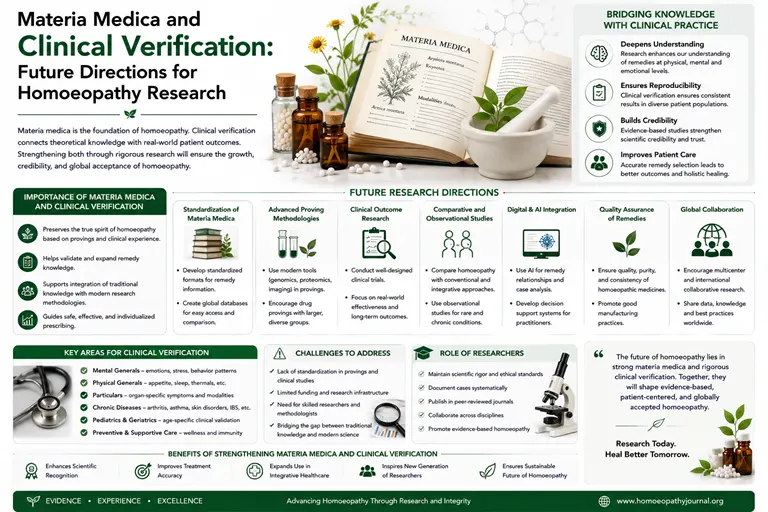
The future of homoeopathy depends not only on preserving classical knowledge but also on validating, refining, and expanding that knowledge through systematic scientific investigation.
Materia Novum: The Journal of Homoeopathy believes that research in Materia Medica and clinical verification represents one of the most important areas of scholarly inquiry and provides significant opportunities for clinicians, academicians, and postgraduate researchers to contribute meaningful evidence to the profession.
Understanding Materia Medica in Homoeopathic Science
Homoeopathic Materia Medica is a systematic collection of drug pictures obtained through:
- Drug provings
- Clinical observations
- Toxicological evidence
- Confirmatory clinical experiences
- Traditional and contemporary research findings
Each remedy within Materia Medica represents a unique symptom pattern that assists practitioners in selecting individualized treatment approaches.
The study of Materia Medica goes beyond memorizing symptoms. It involves understanding:
- Characteristic symptomatology
- Mental and emotional presentations
- Physical generals and particulars
- Modalities and concomitants
- Remedy relationships
- Constitutional tendencies
As healthcare evolves, there is growing recognition that these classical descriptions should continue to be critically examined and clinically verified.
What Is Clinical Verification in Homoeopathy?
Clinical verification is the process of confirming symptoms and indications described in Materia Medica through actual clinical practice and systematic observation.
The concept of clinical verification serves several purposes:
- Confirms remedy indications.
- Identifies new clinical applications.
- Strengthens scientific credibility.
- Improves prescribing accuracy.
- Expands therapeutic understanding.
- Bridges classical knowledge and modern evidence.
Clinical verification transforms individual clinical experiences into scientific evidence that can benefit the wider homoeopathic community.
Why Clinical Verification Matters Today
Modern medical science places great emphasis on measurable evidence and reproducibility. For homoeopathy to continue progressing as a scientific discipline, remedy indications must be supported by well-documented observations and research.
Clinical verification contributes to:
- Evidence-based homoeopathy
- Better educational resources
- Improved patient care
- Standardization of clinical knowledge
- Development of research priorities
- International acceptance of homoeopathic literature
Without continuous verification and documentation, valuable clinical experiences may remain isolated and fail to contribute to the advancement of the profession.
Historical Importance of Clinical Verification
Many of the remedies widely used today gained their reputation through repeated clinical verification.
The process of verification has historically helped:
- Confirm proving symptoms.
- Eliminate doubtful indications.
- Identify keynote symptoms.
- Discover new therapeutic applications.
- Improve remedy differentiation.
The work of early homoeopathic pioneers demonstrates the importance of observing and documenting clinical outcomes carefully.
Modern researchers have the opportunity to continue this tradition using contemporary scientific methodologies.
Current Challenges in Materia Medica Research
Despite its importance, research in Materia Medica faces several challenges.
Limited Clinical Documentation
Many valuable clinical observations remain unpublished and are lost over time.
Lack of Standardized Methodology
Variations in documentation and reporting standards make it difficult to compare findings across studies.
Insufficient Multicenter Studies
Most observations are generated within individual clinics or institutions, limiting the generalizability of findings.
Underutilization of Digital Technology
Many opportunities for data collection and analysis remain unexplored.
Need for Greater Research Collaboration
Collaborative research networks can significantly improve the quality and impact of clinical verification studies.
Addressing these challenges is essential for the future development of homoeopathic science.
Future Directions for Materia Medica Research
Several emerging trends are likely to shape future research in Materia Medica and clinical verification.
Digital Clinical Registries
Digital case registries can enable researchers to collect large amounts of clinical data from multiple centers.
These databases can help identify:
- Frequently verified symptoms
- Emerging remedy indications
- Long-term treatment outcomes
- Patterns of clinical response
Evidence-Based Clinical Verification
Future studies should emphasize:
- Standardized documentation
- Outcome measurements
- Statistical analysis
- Transparent reporting
This approach can strengthen the scientific credibility of homoeopathic literature.
Integration of Artificial Intelligence
Artificial intelligence and data analytics have the potential to transform homoeopathy research.
Possible applications include:
- Pattern recognition
- Symptom clustering
- Clinical decision support
- Predictive analytics
- Large-scale remedy analysis
AI technologies may eventually help identify previously unrecognized remedy relationships and indications.
Multicenter Collaborative Studies
Collaborative research involving homoeopathic colleges, hospitals, and private practitioners can significantly improve the quality of evidence.
Multicenter studies offer several advantages:
- Larger sample sizes
- Greater diversity of patients
- Improved reliability
- Better generalizability of findings
Re-Verification of Classical Remedies
Many classical remedies continue to require modern clinical evaluation.
Research opportunities include:
- Reassessment of keynote symptoms
- Evaluation of lesser-known remedies
- Comparative clinical studies
- Long-term outcome assessments
Research on Rare and Lesser-Used Remedies
Numerous remedies remain underexplored in contemporary practice.
Scientific studies involving lesser-used remedies may:
- Expand therapeutic options.
- Generate new hypotheses.
- Improve clinical understanding.
- Enrich the existing Materia Medica.
Integration with Public Health Research
Public health research offers another important direction for Materia Medica studies.
Researchers may investigate:
- Population-based observations
- Community health applications
- Chronic disease management
- Integrative healthcare models
- Cost-effectiveness studies
The Importance of Case Reports in Clinical Verification
Case reports remain one of the most valuable tools for clinical verification.
A carefully documented case report can:
- Verify remedy indications.
- Demonstrate therapeutic outcomes.
- Identify new clinical applications.
- Encourage larger investigations.
- Contribute to educational literature.
High-quality case reports continue to play an essential role in the evolution of Materia Medica.
Publication Opportunities in Materia Medica Research
There is increasing demand for scholarly publications that contribute to evidence-based homoeopathy.
Researchers can contribute through:
- Original research articles
- Clinical verification studies
- Case reports and case series
- Review articles
- Comparative analyses
- Educational research
- Public health studies
- Integrative medicine research
Materia Novum: The Journal of Homoeopathy welcomes scholarly contributions that advance the understanding of Materia Medica, clinical verification, and scientific homoeopathic practice.
The journal encourages submissions from:
- Clinicians
- Faculty members
- Researchers
- Postgraduate scholars
- Independent practitioners
- Interdisciplinary healthcare professionals
How Young Researchers Can Contribute
Young researchers and postgraduate students have enormous opportunities in this field.
Potential research projects include:
- Verification of specific remedies
- Comparative remedy studies
- Digital case registries
- Literature reviews
- Longitudinal observational studies
- Community-based research
- Clinical documentation projects
By participating in research and publication activities, young professionals contribute significantly to the future growth of homoeopathy.
Why Scholarly Publishing Is Essential for the Future of Materia Medica
Research that remains unpublished cannot effectively contribute to scientific progress.
Academic publishing helps:
- Preserve clinical experiences.
- Share knowledge internationally.
- Build evidence-based practice.
- Improve educational resources.
- Encourage scientific discussion.
- Strengthen professional credibility.
Quality journals therefore play an essential role in ensuring that valuable clinical observations become part of the collective scientific knowledge of homoeopathy.
Frequently Asked Questions
What is clinical verification in homoeopathy?
Clinical verification is the process of confirming remedy indications and symptoms described in Materia Medica through systematic clinical observation and documentation.
Why is Materia Medica research important?
Materia Medica research strengthens scientific evidence, improves prescribing accuracy, and contributes to evidence-based homoeopathic practice.
Can case reports contribute to clinical verification?
Yes. Properly documented case reports are one of the most important sources of clinical verification and often generate new research questions.
What are the future directions of Materia Medica research?
Digital registries, artificial intelligence, multicenter studies, evidence-based verification, and public health research represent important future directions.
Can postgraduate students publish Materia Medica research?
Absolutely. Postgraduate scholars can contribute through case reports, observational studies, literature reviews, and clinical verification projects.
Conclusion
Materia Medica and clinical verification remain the heart of homoeopathic science. As healthcare increasingly embraces evidence-based approaches, the need for systematic documentation, scientific verification, and modern research methodologies has never been greater.
The future of homoeopathy depends on the ability of researchers and clinicians to preserve classical knowledge while continuously validating and expanding it through rigorous scientific inquiry. Clinical verification not only improves prescribing accuracy but also strengthens the credibility and global acceptance of homoeopathic practice.
Materia Novum: The Journal of Homoeopathy remains committed to promoting high-quality research in Materia Medica and encouraging clinicians, academicians, and researchers to contribute meaningful scientific evidence that will shape the future of homoeopathic medicine.
Researchers, educators, and practitioners are encouraged to document their clinical experiences and share their findings through scholarly publication to advance the science and practice of homoeopathy.