


How to Write a High-Quality Homoeopathy Case Report for Journal Publication
How to Write a High-Quality Homoeopathy Case Report for Journal Publication
Case reports have always occupied a special place in the development of homoeopathic science. Many of the remedies, clinical indications, and therapeutic observations that are widely accepted today initially emerged through carefully documented individual cases. In fact, the history of homoeopathy is deeply connected with systematic case documentation and the sharing of clinical experiences among practitioners and scholars.
Even in the era of evidence-based medicine, case reports continue to play an important role in medical literature. They provide valuable clinical insights, generate new research hypotheses, document unusual presentations, and contribute to the continuous expansion of Materia Medica and clinical verification.
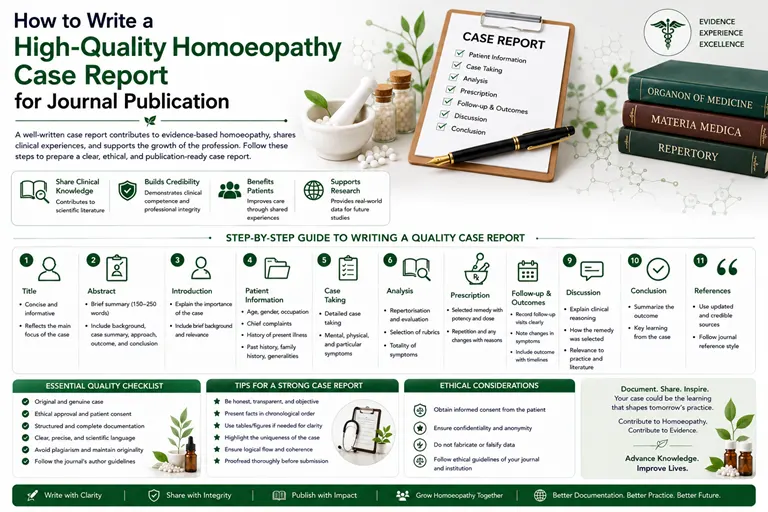
For homoeopathic practitioners, academicians, and postgraduate scholars, publishing high-quality case reports offers an excellent opportunity to contribute to scientific knowledge while also improving academic and professional development.
Materia Novum: The Journal of Homoeopathy encourages clinicians and researchers to publish well-documented case reports that advance evidence-based homoeopathic practice and enrich the scientific literature of homoeopathy.
Why Are Case Reports Important in Homoeopathy?
Homoeopathy is fundamentally an individualized system of medicine. Every patient presents with a unique combination of symptoms, modalities, constitutional characteristics, and life experiences.
Because of this individualized nature, case reports provide an effective method for documenting:
- Unique clinical presentations
- Rare disease manifestations
- New therapeutic observations
- Long-term treatment outcomes
- Clinical verification of remedies
- Patient-centered treatment experiences
- Integrative healthcare applications
Many important clinical observations in homoeopathy have originated from carefully documented case reports.
Scientific Importance of Case Reports
Although randomized controlled trials and systematic reviews are considered high levels of evidence, case reports remain valuable because they:
- Generate new research hypotheses.
- Identify potential therapeutic applications.
- Document unexpected clinical outcomes.
- Encourage larger studies.
- Provide educational resources for practitioners and students.
- Support clinical verification of remedies.
A well-written case report can become the foundation for future observational studies and clinical research.
Characteristics of a High-Quality Homoeopathy Case Report
A publishable case report should possess several important characteristics.
Originality
The case should provide new information, unusual observations, or significant educational value.
Scientific Documentation
All clinical findings should be documented accurately and systematically.
Ethical Standards
Patient confidentiality and informed consent must be maintained.
Clear Clinical Reasoning
The process of case analysis and remedy selection should be explained transparently.
Educational Value
The report should provide useful information that contributes to clinical practice and scientific understanding.
Selecting a Suitable Case for Publication
Not every clinical case is suitable for publication.
Cases that often make valuable contributions include:
- Rare clinical conditions
- Unusual remedy responses
- Long-term follow-up cases
- Cases involving lesser-known remedies
- Cases demonstrating clear clinical verification
- Integrative healthcare cases
- Cases with significant improvement in quality of life
- Cases that generate new research questions
The educational significance of the case should always be considered before writing the manuscript.
Essential Components of a Homoeopathy Case Report
A high-quality case report should follow a clear and structured format.
Title
The title should be:
- Concise
- Informative
- Specific
- Search engine friendly
Examples:
- Homoeopathic Management of Chronic Psoriasis: A Case Report
- Clinical Verification of Lycopodium in Recurrent Migraine: A Case Study
Abstract
The abstract should briefly summarize:
- Background
- Patient presentation
- Intervention
- Outcome
- Clinical significance
A well-written abstract increases the likelihood of readership and citation.
Introduction
The introduction should explain:
- Background of the disease
- Clinical relevance
- Existing literature
- Rationale for reporting the case
The introduction should remain concise and focused.
Patient Information
Provide detailed patient information, including:
- Age
- Gender
- Occupation
- Presenting complaints
- Medical history
- Family history
- Past treatment history
- Lifestyle factors
Patient confidentiality should always be protected.
Clinical Findings
Document:
- Physical findings
- General symptoms
- Mental and emotional symptoms
- Characteristic symptoms
- Diagnostic investigations
Accurate documentation significantly improves the scientific quality of the report.
Case Analysis and Evaluation
This is one of the most important sections in a homoeopathic case report.
Explain:
- Totality of symptoms
- Characteristic features
- Repertorization process
- Differential remedy analysis
- Final remedy selection
Readers should clearly understand the reasoning behind the prescription.
Therapeutic Intervention
Include:
- Name of remedy
- Potency
- Repetition schedule
- Follow-up plan
- Adjunctive measures, if any
Transparency in therapeutic intervention is essential.
Follow-Up and Outcomes
A strong case report should provide detailed follow-up information.
Include:
- Changes in symptoms
- Timeline of improvement
- Objective findings
- Laboratory investigations
- Quality of life improvements
- Duration of follow-up
Long-term follow-up adds considerable value to a case report.
Discussion
The discussion section should explain:
- Clinical significance of the case
- Comparison with existing literature
- Contribution to Materia Medica
- Clinical verification aspects
- Potential implications for future research
Avoid overstating conclusions that are not supported by evidence.
Conclusion
The conclusion should summarize:
- Major observations
- Educational value
- Research implications
- Recommendations for future studies
Importance of Clinical Documentation
Poor documentation is one of the main reasons why many case reports fail to achieve publication.
Researchers should maintain:
- Accurate case records
- Laboratory reports
- Follow-up notes
- Photographic documentation when appropriate
- Standardized assessment tools
Proper documentation strengthens scientific credibility.
Ethical Considerations in Case Report Writing
Ethical standards are essential in medical publishing.
Authors should ensure:
- Informed patient consent
- Protection of patient identity
- Honest reporting of outcomes
- Transparency regarding limitations
- Disclosure of conflicts of interest
Ethical compliance improves the reliability and credibility of published work.
Common Reasons for Rejection of Case Reports
Many manuscripts are rejected because of avoidable mistakes.
Common reasons include:
- Incomplete documentation
- Poor case selection
- Lack of follow-up data
- Weak discussion section
- Inadequate literature review
- Unclear remedy selection process
- Poor writing quality
- Ethical deficiencies
Understanding these issues can significantly improve publication success.
The Role of Case Reports in Evidence-Based Homoeopathy
Case reports continue to contribute to evidence-based homoeopathy by:
- Generating new research questions
- Expanding Materia Medica
- Supporting clinical verification
- Encouraging observational research
- Identifying promising therapeutic areas
A single high-quality case report may inspire larger scientific investigations.
Publication Opportunities for Homoeopathy Case Reports
There is increasing demand for well-written and scientifically documented case reports in homoeopathy.
Potential areas include:
- Chronic disease management
- Pediatric homoeopathy
- Mental health
- Dermatology
- Allergic disorders
- Women's health
- Integrative healthcare
- Rare clinical presentations
Materia Novum: The Journal of Homoeopathy welcomes high-quality case reports that contribute to evidence-based homoeopathy and clinical understanding.
The journal encourages submissions from:
- Practicing clinicians
- Faculty members
- Postgraduate scholars
- Researchers
- Independent practitioners
- Interdisciplinary healthcare professionals
Tips for Young Researchers and Postgraduate Scholars
If you are writing your first case report:
- Choose an educational case.
- Maintain detailed clinical records.
- Review existing literature thoroughly.
- Seek mentorship from experienced faculty.
- Follow journal author guidelines carefully.
- Revise the manuscript multiple times before submission.
Publishing case reports is often the first step toward a successful research career.
Why Publishing Case Reports Matters
Scientific knowledge advances through careful observation and communication.
Publishing case reports helps:
- Preserve valuable clinical experiences.
- Share knowledge internationally.
- Improve professional standards.
- Support educational activities.
- Build evidence-based practice.
- Encourage scientific discussion.
Well-documented case reports remain one of the most valuable contributions that clinicians can make to the advancement of homoeopathic science.
Frequently Asked Questions
What is a homoeopathy case report?
A homoeopathy case report is a detailed description of a patient's clinical presentation, homoeopathic treatment, follow-up, and outcomes.
Why are case reports important in homoeopathy?
They contribute to clinical verification, generate research hypotheses, and enrich scientific literature.
Can postgraduate students publish case reports?
Yes. Case reports are excellent research and publication opportunities for postgraduate scholars.
How long should a case report be?
The length depends on the journal's author guidelines, but clarity and completeness are more important than length.
What makes a case report publishable?
Originality, proper documentation, clear clinical reasoning, ethical standards, and educational value are key factors.
Conclusion
Case reports remain an essential component of homoeopathic literature and continue to play a vital role in the growth of evidence-based homoeopathy. They provide valuable clinical insights, contribute to Materia Medica and clinical verification, and often serve as the foundation for future scientific investigations.
For clinicians, researchers, and postgraduate scholars, learning how to write a high-quality case report is an important academic skill that can significantly contribute to both personal development and the advancement of the profession.
Materia Novum: The Journal of Homoeopathy remains committed to promoting high-quality clinical documentation and encourages practitioners and researchers to share their valuable clinical experiences through scholarly publication.
Researchers and clinicians are invited to submit scientifically documented case reports and contribute to strengthening the evidence base of homoeopathic medicine.