


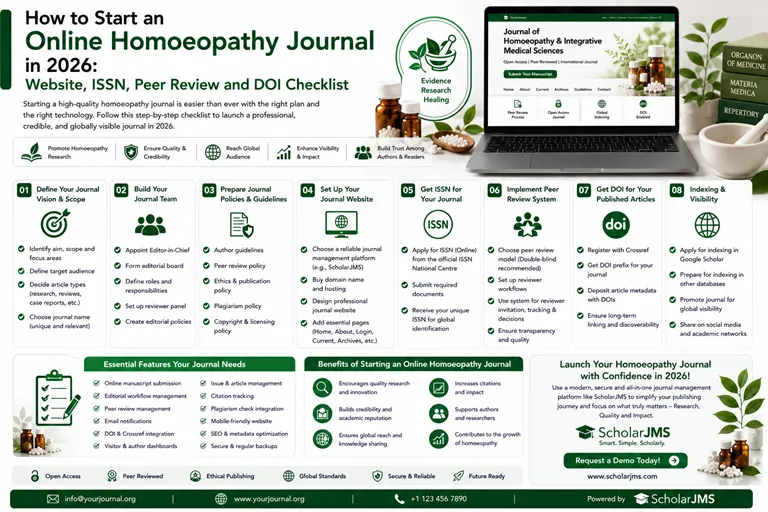
How to Start an Online Homoeopathy Journal in 2026: Website, ISSN, Peer Review and DOI Checklist
How to Start an Online Homoeopathy Journal in 2026: Website, ISSN, Peer Review and DOI Checklist
The field of homoeopathy continues to grow through clinical practice, research, education, and evidence-based publications. Around the world, homoeopathic colleges, professional associations, research institutes, and independent scholars are increasingly interested in establishing scholarly journals to promote scientific communication and disseminate research findings.
The transition toward digital publishing and open-access models has made it easier than ever to launch an academic journal. However, creating a successful journal requires much more than designing a website and publishing articles. It requires strategic planning, editorial governance, ethical policies, digital infrastructure, indexing readiness, and long-term sustainability.
Several successful homoeopathy journals, including Materia Novum: The Journal of Homoeopathy, demonstrate how a well-managed online journal can become an important platform for advancing homoeopathic science and research. The journal has been published online since 2017 with an e-ISSN and a quarterly publication schedule, highlighting the importance of proper planning and digital publishing infrastructure.
If you are planning to launch a new homoeopathy journal in 2026, this comprehensive guide will help you understand the essential steps involved.
Why Start a New Homoeopathy Journal?
Homoeopathy research continues to expand in areas such as:
- Clinical case reports
- Integrative medicine
- Chronic disease management
- Materia Medica research
- Public health studies
- Medical education
- Clinical verification studies
- Systematic reviews and evidence-based research
Despite this growth, many researchers still struggle to find appropriate publication platforms for their work. Launching a quality journal can:
- Encourage scientific communication.
- Support young researchers and postgraduate scholars.
- Improve institutional visibility.
- Promote evidence-based homoeopathy.
- Build national and international collaborations.
- Preserve valuable clinical experiences.
Step 1: Define the Vision and Scope of the Journal
Every successful journal begins with a clear mission.
Before launching your journal, determine:
Journal Title
Choose a unique and meaningful title that reflects your academic focus.
Scope and Subject Areas
Decide whether your journal will publish:
- Clinical research
- Case reports
- Materia Medica studies
- Integrative medicine research
- Public health studies
- Educational research
- Review articles
Target Audience
Your audience may include:
- Homoeopathic practitioners
- Researchers
- Faculty members
- Postgraduate scholars
- Medical educators
- Integrative healthcare professionals
A clearly defined scope helps attract the right authors and reviewers.
Step 2: Build a Professional Journal Website
In 2026, an academic journal cannot succeed without a professional digital presence.
Your journal website should include:
- Home page
- About Journal
- Aims and Scope
- Editorial Board
- Author Guidelines
- Publication Ethics
- Peer Review Policy
- Contact Information
- Current Issues
- Archives
- Manuscript Submission System
The website should also be:
- Mobile responsive
- Secure
- Search engine optimized
- Fast loading
- Easy to manage
A modern journal website improves author experience and enhances the journal's professional credibility.
Why Journal Management Software Matters
Managing submissions manually through email is no longer practical.
Modern journals require:
- Online manuscript submission
- Reviewer assignment
- Editorial workflow management
- Automated email communication
- Publication management
- DOI integration
- Author dashboards
Platforms such as:
provide complete journal website and editorial workflow solutions specifically designed for scholarly publishing.
Step 3: Establish an Editorial Board
A strong editorial board is one of the most important assets of an academic journal.
Include experts from:
- Homoeopathic medical colleges
- Research institutions
- Universities
- Public health organizations
- International academic communities
The editorial board should include:
- Editor-in-Chief
- Associate Editors
- Managing Editors
- Editorial Board Members
- Statistical Advisors
- Language Editors
A respected editorial board significantly improves the credibility of the journal.
Step 4: Develop a Peer Review System
Peer review is the foundation of scholarly publishing.
Your journal should establish:
Double-Blind Peer Review
Both authors and reviewers remain anonymous.
Editorial Screening
Manuscripts should undergo:
- Scope verification
- Ethical screening
- Plagiarism assessment
- Technical checks
Reviewer Selection
Reviewers should possess:
- Subject expertise
- Research experience
- Publication experience
A transparent peer review process improves publication quality and trust.
Step 5: Prepare Journal Policies and Author Guidelines
Every journal should publish clear policies regarding:
- Publication ethics
- Plagiarism
- Conflict of interest
- Data sharing
- Corrections and retractions
- Copyright
- Open access licensing
Author guidelines should explain:
- Manuscript structure
- Reference style
- Figures and tables
- Ethical requirements
- Submission procedures
Clear policies reduce confusion and improve manuscript quality.
Step 6: Apply for ISSN
An ISSN (International Standard Serial Number) is an essential identifier for scholarly journals.
An ISSN:
- Identifies the journal globally.
- Improves discoverability.
- Supports indexing applications.
- Enhances credibility.
Before applying for an ISSN, your journal should have:
- Functional website
- Editorial board
- Publication policies
- Journal information pages
- Publishing plan
Many new publishers find the ISSN application process challenging.
Need Help with ISSN Consulting?
OJSCloud provides support for:
- Journal launch consulting
- ISSN readiness assessment
- Journal website preparation
- Publishing workflows
- Technical documentation
Contact Us
WhatsApp: +91 82003 85143
Email: inquiry@ojscloud.com
Step 7: Plan Your DOI Strategy from Day One
Many new journals delay DOI planning until after publication. This often creates unnecessary complications.
A DOI (Digital Object Identifier) provides:
- Permanent article identification
- Improved discoverability
- Better citation management
- International credibility
- Easier indexing and metadata management
Crossref DOI registration should be planned before launching the journal.
DOI Support for New Journals
GetDOI can assist journals with:
- Crossref membership guidance
- DOI setup
- Metadata workflows
- DOI management strategies
- Technical implementation support
Need DOI Support?
WhatsApp: +91 82003 85143
Email: inquiry@ojscloud.com
Step 8: Prepare Publication Ethics and Transparency Policies
Modern journals are expected to maintain high standards of publication ethics.
Important policies include:
- Publication ethics statement
- Misconduct policies
- Authorship criteria
- Corrections and retractions
- Conflict of interest disclosures
- Data availability statements
Transparent policies improve author trust and support future indexing applications.
Step 9: Build a Reviewer Network
Finding qualified reviewers is often one of the biggest challenges for new journals.
Develop a reviewer database by:
- Inviting experts from institutions.
- Creating reviewer registration forms.
- Networking at conferences.
- Collaborating with researchers.
Reviewer engagement significantly influences publication quality and turnaround time.
Step 10: Publish Your First Issue Strategically
Many successful journals begin with:
- Invited articles
- Review papers
- Editorials
- Faculty contributions
- Conference papers
- Student research projects
The first issue should demonstrate:
- Editorial quality
- Scientific rigor
- Professional presentation
- Technical consistency
Step 11: Plan for Indexing and Long-Term Growth
Indexing readiness should be considered from the beginning.
Prepare for future applications by maintaining:
- Publication regularity
- Ethical standards
- Article metadata
- DOI registration
- Editorial transparency
- Quality peer review
Long-term consistency is one of the most important factors in journal growth.
Should You Use OJS or a Modern Journal Management Platform?
Many journals still use traditional publishing systems that require significant technical maintenance.
Modern platforms can provide:
- Better user experience
- Easier workflow management
- Improved automation
- Professional website design
- Faster implementation
- Technical support
Many publishers are now migrating to integrated journal management systems that combine website management, submission workflows, peer review, and publication tools in a single platform.
Need Help Launching or Upgrading Your Journal?
We can help with:
- Journal website development
- ScholarJMS setup
- OJS migration
- ISSN consulting
- Crossref DOI support
- Editorial workflow setup
- Journal launch consulting
- Publishing infrastructure planning
WhatsApp: +91 82003 85143
Email: inquiry@ojscloud.com
Building Trust Through Transparent Publishing
Modern scholarly publishing increasingly emphasizes transparency, accountability, and research integrity.
Platforms such as:
are contributing toward research trust ecosystems and transparent scholarly communication.
Journals that embrace transparency are more likely to gain long-term credibility among authors, reviewers, and readers.
Frequently Asked Questions
Can I start an online homoeopathy journal without a large budget?
Yes. Many journals begin with modest resources and grow gradually with proper planning and digital infrastructure.
Is ISSN mandatory for a journal?
While a journal can technically publish without an ISSN, obtaining one significantly improves credibility and discoverability.
When should I obtain DOI registration?
DOI planning should be considered before publishing the first issue.
How many editorial board members should a new journal have?
There is no fixed number, but a diverse and qualified editorial board improves credibility.
Can colleges and institutions start their own homoeopathy journals?
Absolutely. Many successful homoeopathy journals are published by educational institutions and professional organizations.
What is the biggest mistake new journals make?
Launching without proper planning for editorial workflow, ISSN, DOI, and long-term sustainability.
Conclusion
Launching an online homoeopathy journal in 2026 is an exciting opportunity to contribute to the advancement of homoeopathic science and evidence-based research. However, successful journal publishing requires much more than publishing articles online. It demands careful planning, professional infrastructure, transparent peer review, ethical standards, and long-term commitment.
The experience of established journals such as Materia Novum: The Journal of Homoeopathy, which has been publishing since 2017 with a structured online presence and quarterly publication model, demonstrates the importance of strong digital publishing foundations.
Whether you are a medical college, professional association, research organization, or independent publisher, investing in the right publishing infrastructure from the beginning can significantly improve the long-term success of your journal.
Need Expert Help to Launch Your Journal?
We can assist with:
- ScholarJMS journal website setup
- OJS migration and support
- ISSN consulting
- Crossref DOI support
- Editorial workflow implementation
- Journal launch and publishing guidance
WhatsApp: +91 82003 85143
Email: inquiry@ojscloud.com
Start your journal with a strong foundation and contribute to the future of homoeopathic research and scholarly communication.