


How to Migrate an OJS Homoeopathy Journal to a Modern Journal Management Platform
How to Migrate an OJS Homoeopathy Journal to a Modern Journal Management Platform
Over the past two decades, thousands of academic journals have adopted Open Journal Systems (OJS) as their publishing platform. OJS has played an important role in promoting open-access publishing and has helped many institutions launch scholarly journals with limited resources.
However, as academic publishing continues to evolve, many journals are now facing new challenges. Authors expect faster workflows, editors require greater automation, and publishers increasingly seek integrated solutions that simplify website management, manuscript handling, metadata management, and DOI workflows.
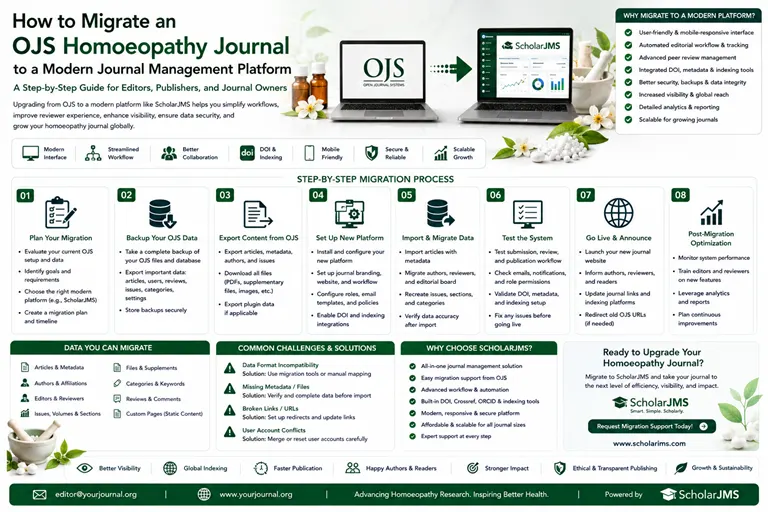
These changing expectations have encouraged many publishers, including medical and homoeopathy journals, to explore migration from traditional publishing systems to modern journal management platforms.
Migrating a journal platform may initially appear complex, but with proper planning and professional guidance, the process can significantly improve editorial efficiency, author experience, and long-term sustainability.
This guide explains why journals migrate, how the migration process works, and what factors should be considered to ensure a smooth transition.
Why Are Journals Migrating Away from Traditional Systems?
Many journals begin with OJS because it is an open-source platform that provides essential publishing tools. However, as journals grow, editors often encounter operational challenges.
Common concerns include:
- Increasing technical maintenance
- Plugin compatibility issues
- Server management responsibilities
- Manual workflows
- Limited automation
- Difficult upgrades
- Need for dedicated technical expertise
- Challenges in implementing new features
For small editorial teams and institutional publishers, these challenges can become significant administrative burdens.
Signs That Your Journal May Need an Upgrade
A journal should consider migration if it experiences:
Frequent Technical Problems
- Website downtime
- Slow loading pages
- Broken plugins
- Security concerns
Increasing Administrative Burden
- Manual reviewer assignment
- Email-based communication
- Difficulty tracking submissions
- Repetitive administrative tasks
Poor User Experience
- Complex submission process
- Author confusion
- Reviewer dissatisfaction
- Mobile usability issues
Difficulty Implementing New Features
- DOI workflows
- Metadata improvements
- Reporting tools
- Workflow automation
If these issues occur regularly, migration may be an appropriate long-term solution.
Benefits of Migrating to a Modern Journal Management Platform
Modern publishing platforms provide numerous advantages.
Improved Editorial Workflow
Modern systems offer:
- Automated communication
- Submission tracking
- Reviewer management
- Editorial dashboards
- Workflow transparency
Better Author Experience
Authors benefit from:
- Simple submission interfaces
- Real-time tracking
- Faster communication
- Mobile-friendly platforms
Enhanced Reviewer Management
Reviewers can:
- Accept assignments easily
- Submit reports efficiently
- Receive automated reminders
- Access manuscripts conveniently
Reduced Technical Burden
Editors can focus on publishing rather than software administration.
Why Homoeopathy Journals Particularly Benefit from Modern Platforms
Homoeopathy journals frequently publish:
- Clinical case reports
- Chronic disease studies
- Materia Medica research
- Integrative medicine research
- Public health studies
- Educational research
Managing these diverse article types requires efficient workflows and organized editorial systems.
Modern platforms can improve:
- Manuscript handling
- Supplementary file management
- DOI assignment
- Metadata quality
- Publication transparency
- Long-term archiving
What Should Be Migrated?
Migration involves much more than transferring a website.
A complete migration plan should consider:
Journal Website Content
- About Journal
- Editorial Board
- Policies
- Author Guidelines
- Contact Information
Published Articles
- Current issues
- Archives
- PDFs
- Supplementary files
Metadata
- Titles
- Authors
- Abstracts
- Keywords
- References
- DOI information
User Accounts
- Editors
- Reviewers
- Authors
Submission Records
- Active manuscripts
- Review history
- Editorial decisions
Proper planning helps avoid data loss and workflow disruptions.
Protecting DOI and Article URLs During Migration
One of the biggest concerns during migration is preserving article discoverability.
DOIs should continue to resolve correctly after migration.
Important considerations include:
- DOI redirection planning
- Metadata updates
- URL mapping
- Testing article accessibility
Proper DOI management protects citations and ensures long-term accessibility.
Metadata Preservation Is Critical
Metadata is one of the most valuable assets of any journal.
Poor migration planning can result in:
- Missing abstracts
- Broken references
- Incorrect author information
- Search engine visibility problems
Careful metadata transfer is essential for maintaining discoverability and indexing readiness.
Preparing for Migration
Before migration begins, journals should conduct a comprehensive review.
Create a Content Inventory
Document:
- Number of issues
- Articles
- User accounts
- DOI records
- Policies
- Active submissions
Review Current Workflows
Identify:
- Existing challenges
- Desired improvements
- Automation requirements
Backup Everything
Always create complete backups of:
- Database
- Website files
- Article PDFs
- Metadata
- User information
A backup strategy significantly reduces migration risks.
Recommended Migration Process
Phase 1: Planning
- Define objectives.
- Evaluate requirements.
- Select the new platform.
Phase 2: Data Preparation
- Organize content.
- Verify metadata.
- Prepare archives.
Phase 3: Migration
- Transfer website content.
- Import articles.
- Configure workflows.
Phase 4: Testing
- Test URLs.
- Verify metadata.
- Confirm DOI functionality.
- Test submission workflows.
Phase 5: Launch
- Announce migration.
- Train editors.
- Monitor performance.
Common Migration Mistakes
Many journals encounter problems because of poor planning.
Common mistakes include:
- Migrating without backups
- Ignoring DOI planning
- Losing metadata
- Failing to test workflows
- Poor communication with users
- Underestimating migration complexity
Avoiding these mistakes can significantly improve the success of the migration project.
Why Many Journals Choose Modern Managed Platforms
Increasingly, journals are adopting managed platforms because they provide:
- Technical support
- Workflow automation
- Website management
- Publishing infrastructure
- Security management
- Easier upgrades
- Faster implementation
These advantages allow editorial teams to focus on scientific publishing rather than technology management.
ScholarJMS: A Modern Publishing Solution
ScholarJMS provides an integrated journal management platform designed to support:
- Journal websites
- Manuscript submission
- Editorial workflows
- Peer review management
- Publication workflows
- DOI-ready infrastructure
- Multi-journal publishing
For many publishers, moving to a managed platform reduces technical burden and improves operational efficiency.
Need Help with OJS Migration?
OJSCloud provides professional services for:
- OJS migration
- Journal website development
- ISSN consulting
- Editorial workflow implementation
- Publishing infrastructure planning
- Journal launch consulting
- Technical support
We Can Help With:
- Complete journal migration
- Metadata transfer
- DOI preservation
- Editorial workflow redesign
- Website modernization
- User training and onboarding
WhatsApp: +91 82003 85143
Direct WhatsApp: https://wa.me/918200385143
Email: inquiry@ojscloud.com
Why DOI Planning Matters During Migration
Migration is also an excellent opportunity to review DOI workflows.
can assist journals with:
- Crossref DOI support
- Metadata corrections
- DOI implementation
- DOI workflow optimization
Proper DOI management ensures that articles remain permanently accessible and citable after migration.
Building Trust Through Modern Publishing Practices
Modern publishing increasingly emphasizes:
- Transparency
- Research integrity
- Better author experiences
- Efficient peer review
- Reliable metadata
Scholar9 supports research trust initiatives and transparent scholarly communication that can further strengthen journal credibility.
Frequently Asked Questions
Can an existing OJS journal be migrated without losing published articles?
Yes. With proper planning and professional execution, articles, metadata, and archives can generally be migrated successfully.
Will DOI links continue to work after migration?
Yes, provided proper DOI management and URL redirection strategies are implemented.
How long does migration usually take?
The timeline depends on the size of the journal, the number of articles, and the complexity of workflows.
Is migration risky?
Every migration project carries some risk, but careful planning, backups, and testing significantly reduce those risks.
Should small journals also consider migration?
Yes. Even smaller journals may benefit from modern platforms if they seek improved workflows and reduced technical responsibilities.
Conclusion
Academic publishing is changing rapidly, and journals must adapt to new expectations regarding usability, transparency, and operational efficiency. While OJS has served the scholarly community well for many years, many medical and homoeopathy journals are now seeking modern publishing solutions that simplify editorial workflows and reduce technical burdens.
Migrating to a modern journal management platform can improve author satisfaction, streamline peer review, strengthen metadata management, and support long-term journal growth.
However, successful migration requires careful planning, protection of metadata and DOI infrastructure, and a clear understanding of editorial requirements.
Whether you are planning a complete migration or simply evaluating your options, investing in a modern publishing ecosystem can significantly improve the future sustainability of your journal.
Ready to Upgrade Your Journal?
We can help with:
- OJS migration and support
- ScholarJMS implementation
- ISSN consulting
- Crossref DOI support
- Editorial workflow design
- Journal website modernization
- Publishing infrastructure planning
WhatsApp: +91 82003 85143
Email: inquiry@ojscloud.com
Modernize your publishing workflow and build a stronger future for homoeopathy research and scholarly communication.