


How to Get ISSN and Crossref DOI for a New Homoeopathy Journal
How to Get ISSN and Crossref DOI for a New Homoeopathy Journal
Launching a new homoeopathy journal is an exciting opportunity to contribute to scientific communication, evidence-based practice, and the advancement of homoeopathic research. However, many journal founders quickly realize that publishing scholarly articles requires more than a website and an editorial board.
To establish credibility and improve discoverability, two important components should be planned from the beginning:
- ISSN (International Standard Serial Number)
- Crossref DOI (Digital Object Identifier)
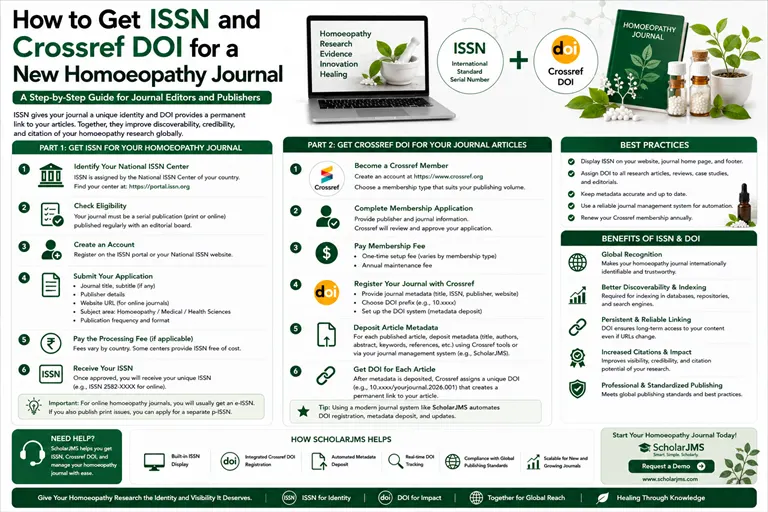
These identifiers help journals become professionally recognized, improve article visibility, and prepare for future indexing opportunities.
Many new publishers are uncertain about how to obtain an ISSN, how DOI registration works, and what preparations are required before applying. This guide explains the process step by step for medical and homoeopathy journals.
What Is an ISSN?
An ISSN is an eight-digit international identifier used to identify serial publications such as journals, magazines, and periodicals, whether published in print or online.
Examples:
- Print ISSN: 1234-5678
- Electronic ISSN (e-ISSN): 2583-4398
An ISSN does not indicate quality or indexing status. Instead, it serves as a unique identifier that helps libraries, databases, and readers distinguish one journal from another.
Why Does a Homoeopathy Journal Need an ISSN?
Obtaining an ISSN provides several advantages:
- Establishes journal identity.
- Improves discoverability.
- Supports indexing applications.
- Enhances credibility.
- Simplifies cataloguing and metadata management.
- Demonstrates publishing professionalism.
Many indexing services and academic databases expect journals to have an ISSN before evaluation.
What Is a Crossref DOI?
A DOI, or Digital Object Identifier, is a permanent digital identifier assigned to scholarly content such as journal articles, books, conference papers, and datasets. Crossref is one of the world's largest DOI registration agencies serving scholarly publishers and research organizations.
A DOI remains stable even if a journal changes servers or migrates to a different platform because the DOI can be updated to point to a new URL.
Examples:
Why Does a Homoeopathy Journal Need DOI Registration?
Crossref DOI registration offers numerous benefits:
- Permanent article identification.
- Better citation tracking.
- Improved discoverability.
- International recognition.
- Better metadata distribution.
- Enhanced long-term preservation.
Crossref also recommends rich metadata deposits because good metadata significantly improves discoverability and connections within the scholarly ecosystem.
Step 1: Build a Professional Journal Website
Before applying for either ISSN or DOI registration, your journal should have a professional website.
Your website should include:
- Home page
- About Journal
- Aims and Scope
- Editorial Board
- Publication Ethics
- Author Guidelines
- Peer Review Policy
- Contact Information
- Current Issue or Sample Issue
- Archives section
- Manuscript Submission System
A professional website demonstrates that the journal is a genuine publishing project and not merely an idea.
Step 2: Prepare Your Editorial Infrastructure
Before applying for ISSN, your journal should have:
- Journal title
- Publishing institution details
- Editorial board
- Publication frequency
- Publishing policies
- Contact information
- Planned publication schedule
Many national ISSN centers require evidence that the journal project is sufficiently developed before assigning an ISSN.
Step 3: Apply for ISSN
ISSN applications are handled by national ISSN centres around the world.
The official ISSN network provides guidance and access to national centres through the ISSN portal.
In India, ISSN applications are generally submitted online according to the procedures established by the national centre.
Typical Documents Required
- Journal title
- Publisher details
- Website URL
- Editorial board information
- Sample issue or published content
- Publication frequency
- Cover page and journal information
Requirements may vary by country and publication type.
Common Reasons ISSN Applications Are Delayed
Many journals experience delays because:
- Website is incomplete.
- Editorial information is missing.
- Policies are not published.
- Publication schedule is unclear.
- Contact information is inadequate.
- Sample content is unavailable.
Preparing these elements beforehand can significantly improve the application process.
Need Help with ISSN Consulting?
OJSCloud provides support for:
- Journal launch consulting
- ISSN readiness assessment
- Journal website preparation
- Editorial workflow setup
- OJS hosting and migration
- Publishing infrastructure planning
Contact Us
WhatsApp: +91 82003 85143
Direct WhatsApp: https://wa.me/918200385143
Email: inquiry@ojscloud.com
Step 4: Plan Your DOI Strategy Early
Many new journals wait until after publication to think about DOI registration. This often creates unnecessary complications.
A good DOI strategy should include:
- DOI structure
- Metadata planning
- Article URL management
- Publication workflow integration
Crossref recommends assigning DOIs to scholarly content that is likely to be cited.
How Does Crossref DOI Registration Work?
The process generally involves:
Become a Crossref Member
Organizations that publish scholarly content may apply for Crossref membership. Once approved, they receive a DOI prefix and access credentials.
Generate DOI Identifiers
Publishers create DOI suffixes for individual articles according to their internal policies.
Deposit Metadata
Metadata is submitted to Crossref and becomes part of the global scholarly ecosystem.
Display DOI Properly
Crossref recommends displaying DOIs as full HTTPS links:
rather than plain text identifiers.
What Metadata Should Journals Deposit?
Good metadata improves discoverability and long-term visibility.
Recommended metadata includes:
- Journal title
- Article title
- Authors
- Abstract
- Keywords
- ORCID identifiers
- Publication date
- References
- Funding information
- License information
Rich metadata significantly improves the usefulness of DOI registration.
Why DOI Matters for Homoeopathy Journals
Homoeopathy research often includes:
- Clinical case reports
- Chronic disease studies
- Integrative medicine research
- Materia Medica studies
- Educational research
- Public health investigations
DOIs help ensure these contributions remain permanently accessible and easily citable.
As evidence-based homoeopathy grows, DOI registration becomes increasingly important for research visibility.
Need Help with Crossref DOI Setup?
GetDOI can assist with:
- Crossref DOI guidance
- Metadata workflow planning
- DOI implementation
- Technical support
- Journal publishing consultation
Need DOI Support?
WhatsApp: +91 82003 85143
Email: inquiry@ojscloud.com
Why a Modern Journal Management System Makes ISSN and DOI Easier
Many technical difficulties arise because journals attempt to manage publishing workflows manually.
Modern journal management platforms can simplify:
- Metadata generation
- DOI workflows
- Editorial management
- Publication scheduling
- Archive management
- Submission workflows
ScholarJMS provides integrated solutions for:
- Journal websites
- Manuscript submission
- Editorial workflows
- Publication management
- DOI-ready infrastructure
This allows editors to focus more on publishing quality research and less on technical administration.
Building a Strong Foundation Before Indexing
Although ISSN and DOI are important, they are only part of a successful publishing strategy.
Journals should also focus on:
- Publication ethics
- Editorial quality
- Regular publication schedules
- Transparent peer review
- Metadata quality
- Long-term sustainability
A strong foundation significantly improves future opportunities for indexing and international recognition.
Frequently Asked Questions
Is ISSN mandatory for an online journal?
A journal can technically publish without an ISSN, but obtaining one significantly improves credibility and discoverability.
Can I apply for ISSN before publishing my first issue?
Requirements vary by country and publication type. Some national centres allow applications when the journal project is sufficiently advanced, while others may require publication evidence.
Is DOI the same as ISSN?
No. ISSN identifies the journal as a serial publication, while DOI identifies individual articles or other scholarly content.
Do I need Crossref membership to obtain a DOI prefix?
Yes. Publishers generally need to become Crossref members or work through approved support arrangements to register Crossref DOIs.
Can a homoeopathy journal obtain DOI registration?
Absolutely. Any eligible scholarly journal publishing citable research can plan DOI registration through Crossref.
Conclusion
Obtaining an ISSN and implementing Crossref DOI registration are among the most important steps in establishing a professional homoeopathy journal. These identifiers improve credibility, discoverability, and long-term accessibility while helping journals build a strong foundation for future growth.
However, successful implementation requires more than simply completing forms. Journals need professional websites, editorial policies, publication workflows, metadata planning, and sustainable publishing infrastructure.
Whether you are launching a new homoeopathy journal or upgrading an existing publication, careful planning of ISSN and DOI workflows can save considerable time and help establish a more credible scholarly presence.
Need Help Launching Your Journal?
We can help with:
- Journal website development
- ScholarJMS setup
- ISSN consulting
- Crossref DOI support
- OJS migration
- Editorial workflow implementation
- Journal launch guidance
WhatsApp: +91 82003 85143
Direct WhatsApp: https://wa.me/918200385143
Email: inquiry@ojscloud.com
Build your journal on a strong publishing foundation and contribute to the future of evidence-based homoeopathy research.