

Evidence-Based Homoeopathy Research: Why Clinical Documentation Matters in Modern Practice
Evidence-Based Homoeopathy Research: Why Clinical Documentation Matters in Modern Practice
The healthcare landscape of the twenty-first century is increasingly driven by evidence, transparency, and measurable outcomes. Healthcare professionals, policymakers, educators, and patients all expect therapeutic interventions to be supported by scientific data and documented clinical experiences. This growing emphasis on evidence-based healthcare has also influenced the field of homoeopathy, creating a strong need for systematic research and high-quality clinical documentation.
Homoeopathy possesses a rich history of clinical observations, individualized treatment approaches, and extensive practical experience. However, much of this valuable knowledge remains underreported or unpublished. Without proper documentation and scientific communication, many important clinical experiences fail to contribute to the broader advancement of homoeopathic science.
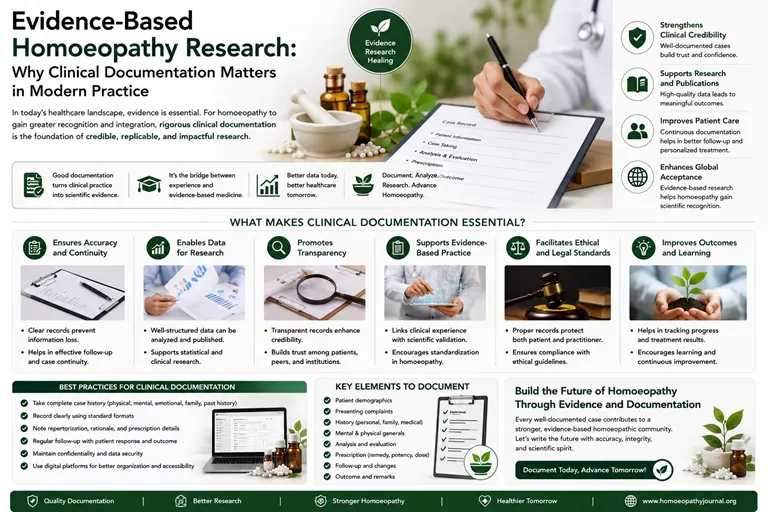
Clinical documentation is therefore no longer merely an administrative activity. It has become an essential component of evidence-based homoeopathy, academic research, education, and professional development.
Materia Novum: The Journal of Homoeopathy strongly believes that systematic documentation and scientific publication are fundamental to strengthening the evidence base of homoeopathy and encouraging meaningful scholarly contributions from clinicians and researchers worldwide.
Understanding Evidence-Based Homoeopathy
Evidence-based homoeopathy refers to the integration of:
- Best available scientific evidence
- Clinical expertise and professional judgment
- Patient values and preferences
The concept does not seek to replace traditional homoeopathic principles. Rather, it aims to strengthen them through systematic observation, scientific evaluation, and transparent reporting.
Evidence-based homoeopathy encourages practitioners to:
- Document clinical experiences.
- Evaluate treatment outcomes.
- Publish research findings.
- Participate in scientific discussions.
- Improve clinical decision-making.
This approach helps bridge the gap between traditional clinical wisdom and modern scientific expectations.
Why Modern Healthcare Demands Better Evidence
Healthcare systems around the world increasingly rely on evidence to guide clinical practice and policy decisions.
Several factors have contributed to this shift:
Rising Burden of Chronic Diseases
Long-term conditions such as diabetes, asthma, arthritis, and mental health disorders require therapies that can demonstrate measurable outcomes.
Increased Patient Awareness
Patients today seek reliable information and expect healthcare providers to support their recommendations with evidence.
Growth of Integrative Healthcare
As complementary and conventional medicine increasingly collaborate, the need for transparent and documented evidence has become even more important.
Academic and Regulatory Expectations
Medical education and scientific publishing place significant emphasis on research methodology, documentation standards, and reproducibility.
These developments make clinical documentation an essential responsibility for modern homoeopathic practitioners.
What Is Clinical Documentation in Homoeopathy?
Clinical documentation refers to the systematic recording of patient information, clinical observations, treatment decisions, and outcomes.
Proper documentation includes:
- Patient demographics
- Presenting complaints
- Detailed case history
- Physical and mental symptoms
- Clinical findings
- Investigations and diagnostic reports
- Case analysis and repertorization
- Remedy selection and prescription
- Follow-up observations
- Treatment outcomes
Comprehensive documentation forms the foundation of scientific research and evidence generation.
Why Clinical Documentation Matters in Modern Practice
Strengthening Scientific Credibility
The credibility of any healthcare system depends on its ability to present reliable and verifiable evidence.
Documented clinical experiences provide:
- Real-world evidence
- Measurable outcomes
- Transparent observations
- Opportunities for independent evaluation
Good documentation helps strengthen the scientific standing of homoeopathy.
Improving Patient Care
Systematic documentation allows clinicians to:
- Monitor patient progress.
- Evaluate treatment effectiveness.
- Identify patterns of improvement.
- Modify treatment strategies appropriately.
Ultimately, better documentation contributes to improved patient outcomes.
Supporting Clinical Verification
Clinical verification has always been an important component of homoeopathic science.
Proper documentation enables practitioners to:
- Confirm remedy indications.
- Identify new clinical applications.
- Validate observations.
- Expand Materia Medica.
Facilitating Research and Publication
Many valuable clinical experiences remain unpublished because of inadequate documentation.
Maintaining accurate records significantly improves the ability to prepare:
- Case reports
- Case series
- Observational studies
- Clinical audits
- Research articles
Documentation therefore acts as the starting point for scientific publication.
Role of Clinical Documentation in Evidence-Based Homoeopathy
Evidence-based homoeopathy depends heavily on the quality of clinical data available.
Clinical documentation contributes to:
Building Research Databases
Large collections of well-documented cases can help researchers:
- Identify treatment patterns.
- Generate hypotheses.
- Develop research priorities.
- Conduct observational studies.
Developing Real-World Evidence
Real-world evidence plays an increasingly important role in healthcare research.
Documented clinical experiences can provide valuable information regarding:
- Patient outcomes
- Treatment effectiveness
- Quality of life
- Long-term management
Supporting Collaborative Research
High-quality documentation allows researchers and institutions to collaborate on multicenter studies and larger scientific investigations.
Essential Components of Good Clinical Documentation
To ensure scientific value, documentation should be:
Accurate
Information should be recorded carefully and precisely.
Complete
Important clinical details should never be omitted.
Timely
Documentation should be completed during or immediately after patient consultations.
Objective
Clinical observations should be recorded honestly and without bias.
Organized
Structured documentation improves readability and future research use.
What Should Be Documented in a Homoeopathic Case?
A comprehensive homoeopathic record should include:
Patient Information
- Age
- Gender
- Occupation
- Medical history
- Family history
- Lifestyle information
Presenting Complaints
- Duration
- Frequency
- Severity
- Progression of symptoms
Characteristic Symptoms
- Mental symptoms
- General symptoms
- Particular symptoms
- Modalities
- Concomitants
Investigations
- Laboratory findings
- Imaging studies
- Diagnostic reports
Treatment Information
- Remedy selected
- Potency prescribed
- Repetition schedule
- Follow-up observations
Outcomes
- Clinical improvement
- Objective findings
- Patient-reported outcomes
- Quality of life changes
Common Documentation Mistakes in Homoeopathic Practice
Several common mistakes reduce the scientific value of clinical records.
These include:
- Incomplete case histories
- Missing follow-up information
- Lack of objective measurements
- Poor organization of records
- Failure to document investigations
- Inconsistent symptom recording
- Absence of outcome measures
Avoiding these mistakes significantly improves research quality.
The Role of Documentation in Case Reports and Research Publications
High-quality publications depend upon high-quality clinical records.
Proper documentation enables researchers to prepare:
Case Reports
Individual cases that contribute to clinical verification and generate research questions.
Case Series
Collections of similar cases that identify patterns and trends.
Observational Studies
Research that evaluates real-world clinical outcomes.
Clinical Audits
Assessments that improve clinical quality and healthcare delivery.
Review Articles
Publications that synthesize existing knowledge and evidence.
Without proper documentation, meaningful research becomes extremely difficult.
Clinical Documentation and Digital Health
The rapid growth of digital technology is transforming healthcare documentation.
Digital systems offer several advantages:
- Improved data storage
- Easy retrieval of information
- Standardized records
- Better follow-up tracking
- Opportunities for large-scale research
Electronic documentation can significantly improve the quality of evidence generation in homoeopathy.
Future Directions in Evidence-Based Homoeopathy Research
Several emerging trends are likely to shape the future of homoeopathy research.
Big Data and Clinical Registries
Large clinical databases can support:
- Population-based research
- Longitudinal studies
- Outcome assessments
Artificial Intelligence
AI technologies may help identify:
- Clinical patterns
- Symptom relationships
- Predictive treatment models
Patient-Reported Outcome Research
Greater emphasis is being placed on understanding patient experiences and quality of life outcomes.
Integrative Healthcare Research
Collaborative healthcare models provide significant opportunities for evidence generation and interdisciplinary research.
Publication Opportunities for Researchers
The increasing focus on evidence-based healthcare has created substantial opportunities for publication in homoeopathy.
Researchers can contribute through:
- Original research articles
- Clinical studies
- Case reports
- Case series
- Review articles
- Systematic reviews
- Public health research
- Integrative healthcare studies
Materia Novum: The Journal of Homoeopathy welcomes scholarly contributions that advance evidence-based homoeopathy and improve scientific understanding through rigorous clinical documentation and research.
The journal encourages submissions from:
- Clinicians
- Faculty members
- Researchers
- Postgraduate scholars
- Public health professionals
- Independent practitioners
Why Young Researchers Should Prioritize Documentation
For postgraduate students and early-career researchers, developing good documentation habits is one of the most valuable professional skills.
Systematic documentation can:
- Improve research productivity.
- Facilitate publication opportunities.
- Enhance clinical decision-making.
- Build academic careers.
- Encourage lifelong learning.
Every well-documented patient encounter has the potential to contribute to scientific knowledge.
Frequently Asked Questions
What is evidence-based homoeopathy?
Evidence-based homoeopathy integrates scientific evidence, clinical expertise, and patient preferences to support informed healthcare decisions.
Why is clinical documentation important?
Clinical documentation strengthens scientific credibility, improves patient care, and facilitates research and publication.
Can clinical records contribute to research?
Yes. Properly documented cases often become the foundation for case reports, observational studies, and larger research projects.
What information should be documented?
Patient history, symptoms, investigations, treatment details, follow-up observations, and outcomes should all be recorded systematically.
Can postgraduate students publish research based on documented cases?
Absolutely. Well-documented cases frequently lead to publishable case reports and research studies.
Conclusion
Evidence-based homoeopathy cannot develop without systematic and high-quality clinical documentation. Every patient encounter provides an opportunity to generate knowledge, validate clinical observations, and contribute to scientific understanding.
In an era increasingly focused on transparency and measurable outcomes, homoeopathic practitioners must embrace documentation as an essential component of professional practice. Good documentation not only improves patient care but also strengthens research, supports publication, and advances the scientific credibility of homoeopathy.
Materia Novum: The Journal of Homoeopathy remains committed to promoting evidence-based research and encourages clinicians, academicians, and postgraduate scholars to document their clinical experiences and contribute meaningful scientific literature that will shape the future of homoeopathic medicine.
Researchers and practitioners are invited to share their findings and participate in building a stronger evidence base for homoeopathy through scholarly publication.