



materianovum@gmail.com
9145002463
e-ISSN: 2583-4398
logo

Materia Novum: The Journal of Homoeopathy

📢 Latest Update: New special issue call for papers on "Emerging Technologies in Research" - Submit by March 31, 2026

📢 Latest Update: New special issue call for papers on "Emerging Technologies in Research" - Submit by March 31, 2026

Volume 4, Issue 1 - 2020 (January-March 2020)

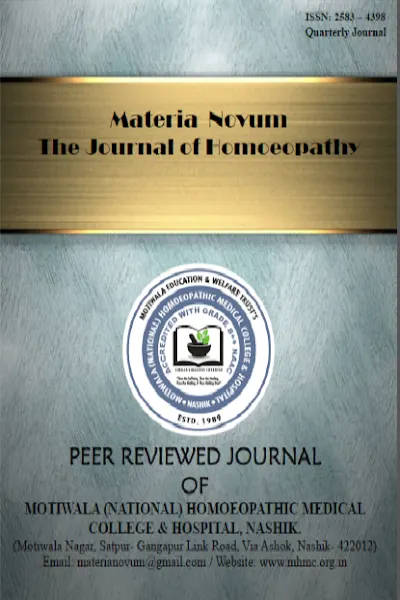
Volume 4 Issue 1 Cover

Issue Details:

Volume 4 Issue 1
Published:Invalid Date

Editorial: January-March 2020

Welcome to the 2020 issue of Materia Novum: The Journal of Homoeopathy. This issue showcases the remarkable breadth and depth of contemporary research across multiple disciplines. From cutting-edge applications of machine learning in climate science to the revolutionary potential of quantum computing in drug discovery, our featured articles demonstrate the power of interdisciplinary collaboration in addressing global challenges.

We are particularly excited to present research that bridges traditional academic boundaries, reflecting our journal's commitment to fostering innovation through cross-disciplinary dialogue. The integration of artificial intelligence with environmental science, the application of blockchain technology to supply chain management, and the convergence of urban planning with smart city technologies exemplify the transformative potential of collaborative research.

As we continue to navigate an era of rapid technological advancement and global challenges, the research presented in this issue offers both insights and solutions that will shape our future. We thank our authors, reviewers, and editorial board members for their continued dedication to advancing knowledge and promoting scientific excellence.

Dr. F. F. Motiwala
Editor-in-Chief
Materia Novum: The Journal of Homoeopathy

Articles in This Issue

Showing 5 of 5 articles
Research PaperID: MNH140001Pages 1

Homoeopathy In Gastritis

Mohit Jain

Gastritis is acute or chronic inflammation of the stomach and is most often diffuse, mostly caused by Helicobacter pylori and bile reflux. It is the commonest disorder encountered in the clinical practice. Change in dietary habits – like having irregular meals, fast foods, addictions like smoking and alcohol also play major role. Although not life threatening as other major illness, the symptoms can be distressing and can cause discomfort to enjoy normal life and drain the mental and physical energy. If gastritis is not treated earlier the complications are grave like peptic ulcer, pyloric stenosis and subsequent perforation. Homoeopathy plays a major role in treating gastritis. Homeopathy is very effective in managing all the acute as well as chronic expressions of gastritis; it also plays an important role in prevention of relapse of the condition.

GastritisHomoeopathyAcute gastritisHelicobacter pylori
18,476 views
5,568 downloads

Contributors:

 Mohit Jain
Research PaperID: MNH140002Pages 4

Role of homoeopathic medicines in ano-rectal diseases

Dr. Kirti Borhade

30 cases of ano-rectal disorders covering inclusion & exclusion criteria (haemorrhoids, fissure, and Ano rectal abscess) are selected by simple randomized sampling method. Cases were collected from college OPD, Private OPD, Camps conducted by college, etc. cases are repertorized using Synthesis 9.0 repertory and remedy which is most similar to the case from the group of similar remedies is prescribed. The outcome assessment is judged on Verbal Analogue Scale for pain, & bleeding and discomfort. At the end, in each case, with subsequent follow up, cases were grouped as IMPROVED (cases with no pain & discomfort), RECOVERED (cases with little improvement), and NOT IMPROVED (cases with no improvement in pain & discomfort). For statistical analysis Verbal Analogue Pain Scale Score before and after the Homoeopathic remedy was used. Out of 30 cases, 29 cases were improved and 1 case was recovered with little improvement. Paired ‘t’ test was used for final conclusion. Calculated value of‘t’ was 31.67 which is greater than table value of ‘t’ at degrees of freedom 29 & at 5% L.O.S (which is 2.05).

Haemorrhoidfissureabscessrepertorization and paired t test
18,883 views
5,701 downloads

Contributors:

 Dr. Kirti Borhade
Research PaperID: MNH140003Pages 7

Homoeopathic Treatment of Encysted Hydrocele: A Case Report

Mahesh Dusane

Encysted Hydrocele is a condition usually affecting children. A case of encysted hydrocele on left side inguinal canal in 11 year old male child was reported. The diagnosis was made encysted hydrocele on the basis of signs and symptoms and ultrasonography. The patient was suggested for the surgery, by the eminent Pediatrician. Surgery was not preferred by parents of the patient. The patient has shown interest to follow, homoeopathy treatment, willingly. A Homoeopathic medicinal management was done and found effective in the case of Encysted Hydrocele with abnormally enlarged scrotum. Patient was advised to follow the Homoeopathic management. Follow up has shownencourageous result.

Encysted hydroceleHomoeopathyUSG
18,876 views
5,683 downloads

Contributors:

 Mahesh Dusane
Research PaperID: MNH140004Pages 10

Research Priorization

Rinky Nishad, Seema Chaure

Research prioritization is an essential process in public health and scientific planning that helps identify the most important areas requiring investigation. Because resources such as funding, infrastructure, and skilled manpower are limited, it is necessary to systematically determine which research topics should receive priority. Research prioritization is a dynamic and continuous process that responds to changing patterns of diseases, evolving health determinants, and emerging public health challenges. Establishing clear research priorities helps ensure that research activities address major health problems affecting populations and contribute effectively to improving health outcomes. The selection of priority areas is generally based on several criteria, including the magnitude of the health problem, its impact on mortality, morbidity, disability, and economic burden, and its relationship to socio economic development. Additionally, the feasibility of finding practical solutions, the potential for improving national health programmes, and the possibility of generating new scientific knowledge are also important considerations. Research priorities may also require regional collaboration when health problems vary across geographic or ecological settings. Ultimately, research prioritization aims to support and strengthen national health systems by guiding research efforts toward issues that have the greatest potential to improve population health and achieve national and global health goals.

Research prioritizationPublic health researchHealth policyResource allocationDisease burdenHealth systems+2 more
18,718 views
5,785 downloads

Contributors:

 Rinky Nishad
,
 Seema Chaure
Research PaperID: MNH140005Pages 11

Teaching Learning Methods in Medical Profession

Dr. S. M. Yadav

Teaching and learning methods play a crucial role in medical education by enhancing students’ understanding, skill development, and professional competence. Effective teaching requires the use of diverse instructional strategies rather than reliance on a single method. Teaching and learning media serve as important tools for communicating educational information and improving knowledge retention. Research suggests that learners remember a higher percentage of information when it is both seen and heard compared to information that is only heard or seen. Various teaching aids such as visual, audio, written, and audiovisual tools support the learning process and help overcome the limitations of oral communication. Medical education employs different teaching approaches depending on the size of the learner group and the objectives of instruction. Large group teaching methods include lectures, symposiums, and panel discussions that facilitate structured presentation of knowledge by experts. Small group teaching methods such as group discussions, seminars, tutorials, demonstrations, and workshops encourage active participation, critical thinking, and collaborative learning among students. Practical sessions, bedside teaching, and field work help bridge the gap between theoretical knowledge and real life clinical practice. Individual learning approaches including reading, programmed learning, projects, and simulations promote self directed learning and problem solving abilities. Each method has specific advantages and limitations, and the effectiveness of teaching depends on the appropriate combination of these methods. Therefore, integrating multiple teaching strategies is essential for achieving comprehensive learning outcomes in medical education.

Medical educationTeaching learning methodsEducational mediaLarge group teachingSmall group teachingSimulation+2 more
19,018 views
5,826 downloads

Contributors:

 Dr. S. M. Yadav
Whatsapp